
A Tale of Two Membranes - Why Some Roofs Last and Others Don’t
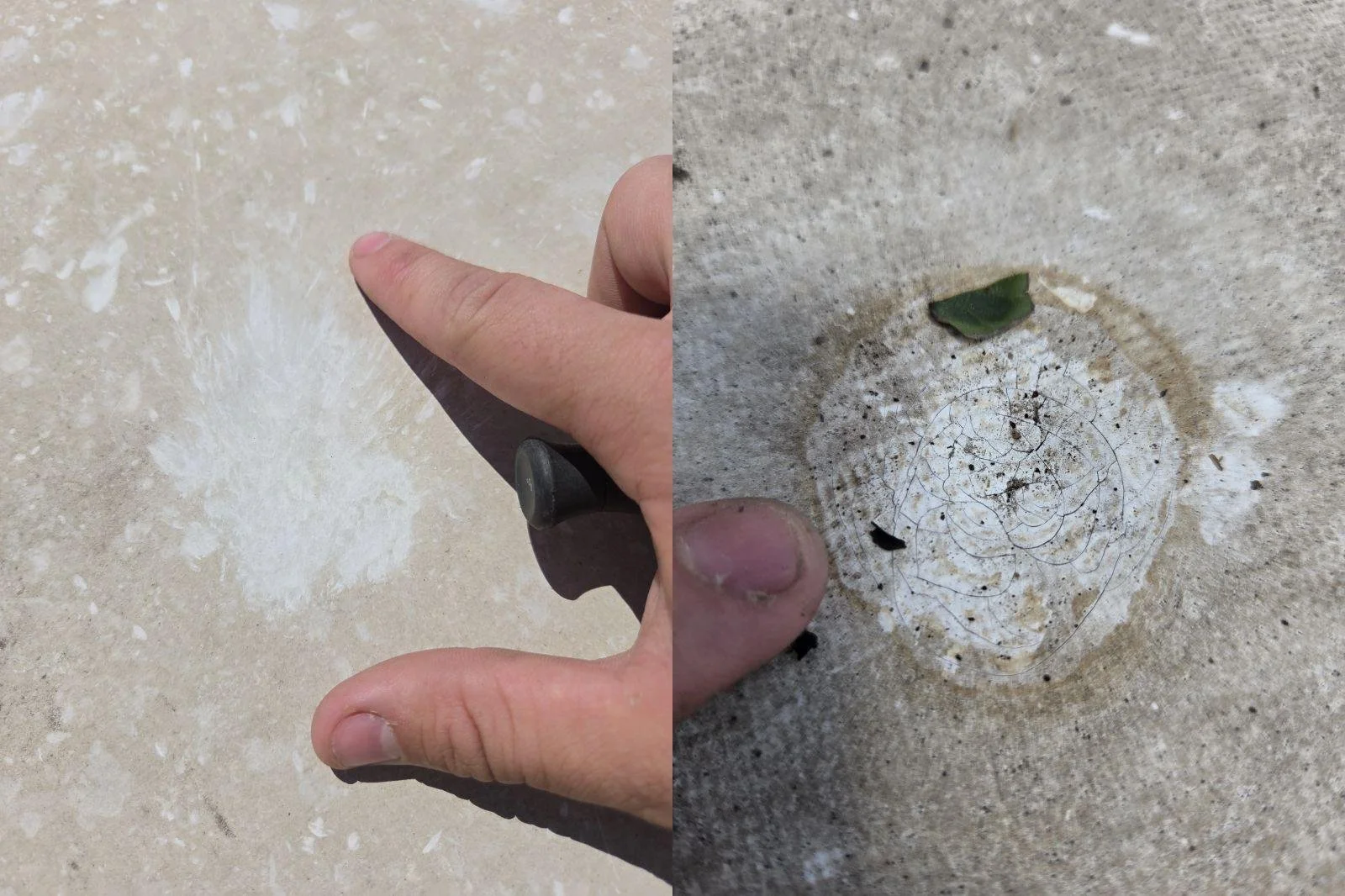
Same storm. Same age. Similar materials. Completely different outcomes — and it all comes down to how the roof was built.
We don’t get comparisons this clean very often. Two single-ply membranes, side by side. Same location, same general age, same hailstorm.
One is visibly crushed, fractured, and leaking. The other is still intact and serviceable.
At first glance, it’s tempting to look for a single variable to explain the difference—one product vs. another, one installer vs. another, one decision that made or broke the system. But roofing systems don’t fail—or succeed—based on one choice alone. What you’re seeing here is the cumulative effect of multiple decisions working together over time.
In this case, it comes down to two things that should never be separated: membrane selection and assembly design.
Membrane selection isn’t just Picking a Brand
There’s a tendency in commercial roofing to treat the membrane as a commodity—something selected based on price, brand familiarity, or what’s “standard” in a spec. But single-ply membranes are not interchangeable.
Different materials behave very differently under stress. Flexibility, elongation, tensile strength, puncture resistance—these aren’t abstract product specs, they directly impact how a roof responds when it’s put under real-world pressure. And hail is one of the clearest stress tests you can get.
Some membranes can absorb and dissipate impact energy. Others are more rigid and prone to compressive damage. Some will rebound after a hit, while others will permanently deform or fracture, even if the damage isn’t immediately obvious from a distance.
If the membrane isn’t selected with the building’s exposure, climate, and risk profile in mind, the system can be vulnerable from day one—long before the first storm ever shows up.
But even that’s only half the story.
A membrane is only as strong as what’s beneath it
Roof systems don’t experience weather in isolation. The membrane is just the outermost layer of a much larger assembly, and everything underneath it plays a role in how it performs.
When hail hits a roof, the membrane doesn’t just “take” the impact—it transfers that energy downward. What happens next depends entirely on the system below it.
Is there a high-density coverboard to spread and absorb the load?
What type of insulation is in place, and what’s its compressive strength?
How is the system attached—mechanically or adhered—and how does that affect movement?
What’s the condition of the deck, and does it provide a stable base?
All of these factors determine whether that impact energy is dissipated across the assembly… or concentrated in one spot, forcing the membrane to take more stress than it was ever designed to handle.
In the failed system, the membrane didn’t just get hit—it got overwhelmed. The energy had nowhere to go. Compression occurred below the surface, the membrane deformed beyond its limits, and the result was immediate failure and active leaks.
In the system that held up, the exact same storm played out very differently. The membrane had the right physical properties, but more importantly, it had support. The assembly underneath helped absorb and distribute the load, allowing the system to flex, recover, and continue performing.
That’s the difference between damage and failure.
Roofing decisions compound over time
The reality is that most roofing problems aren’t caused by catastrophic mistakes—they’re caused by a series of “good enough” decisions that don’t account for how the system actually works as a whole.
Choosing a membrane without considering the assembly. Installing insulation without thinking about impact resistance. Skipping a coverboard to save cost. Assuming that because something works in one application, it will work in every application.
None of those decisions feel critical in isolation. But together, they define how a roof performs years down the line, when it’s exposed to real stress.
What these two membranes show is the long-term impact of those decisions finally becoming visible.
How Fortress approaches it
We don’t approach roofing as a product selection exercise—we approach it as a system design problem.
Before we recommend a membrane, we look at the building as a whole: how it’s used, where it’s located, how it drains, what it’s exposed to, and what kind of risks it realistically faces over its lifespan. From there, we design an assembly where each component supports the next—membrane, coverboard, insulation, attachment—so the system performs as one unit.
Because when those decisions are made together, you don’t just get a roof that looks good on install day—you get one that holds up when it matters.
What you’re seeing in these photos isn’t bad luck, and it isn’t random.
It’s the difference between a roof that was designed to handle stress—and one that wasn’t.
And that difference only shows up when the storm hits.
